Hungry Humpbacks
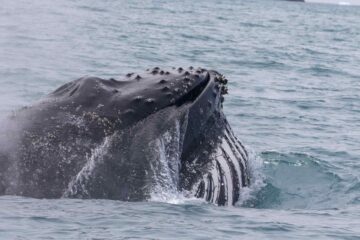
Hungry Humpbacks studied how humpback whales, the largest predators of krill in the region, fed at South Georgia.

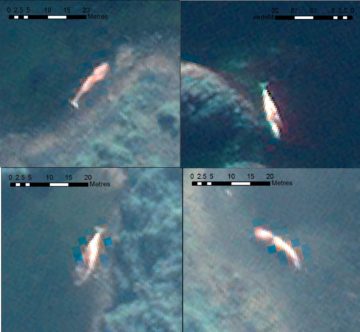
I am a marine conservationist and remote sensor PhD Researcher, studying cetacean mass strandings and ocean health from space, with SENSE Earth Observation CDT, based at the British Antarctic Survey and the University of Edinburgh. This is an internationally collaborative project with University of Massey, CEAZA, Oceanswell, and JNCC working to develop satellite imagery as a tool for long term stranding monitoring programmes in remote areas, with the aim to:
The team is also working to collaborate across remote sensing fields to understand predictors for strandings events, to enable a quicker and more informed stranding response. The team hopes to develop this technology using open access software, developing accessible training resources and to develop partnerships with satellite companies to create greater equality of access to satellite data.
As an ocean educator, I hope to change the trajectory for our world’s oceans through science communication. I am Lead Producer of the European Commissions, EU4Ocean podcast, ‘If Oceans Could Speak’. The podcast shares the stories about the oceans around us, their value and vulnerability, as told through individual connections, to raise awareness for, and inspire positive action towards ocean and environmental stewardship. I have also consulted on the Antarctic Glaciers ‘The Antarctic Storymap Collection’, a free Antarctic resource for key stage 3 students, and assisted in the organisation and hosting of Polar Pint of Science.
I am a member of the Society for Marine Mammalogy.
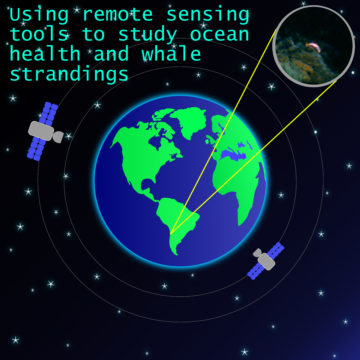
Project Name: Cetacean Strandings from Space: Using remote sensing tools to study ocean health and whale strandings
Project Team:
Primary Supervisor: Dr Jennifer Jackson (British Antarctic Survey)
Supervisors: Dr Encarni Medina-Lopez (University of Edinburgh), Dr Peter Fretwell, Professor Karen Stockin (University of Massey), Dr Carlos Ollavaria (CEAZA), and Dr Gwawr Jones (JNCC)
Advisors: Dr Asha de Vos (Oceanswell), Dr Hannah Cubaynes (British Antarctic Survey)
Case Partner: JNCC
Wintering whales of the Western Antarctic Peninsula, World Wildlife Fund (WWF) – Ongoing
Geospatial Artificial Intelligence for Animals, National Oceanic and Atmospheric Administration (NOAA) – Ongoing
Clarke, P. J., H. C. Cubaynes, K. A. Stockin, C. Olavarría, A. de Vos, P. T. Fretwell, J. A. Jackson (In press). Cetacean strandings from space: Challenges and opportunities of very high resolution satellites for the remote monitoring of cetacean mass strandings. Frontiers in Marine Science. doi: 10.3389/fmars.2021.650735
Höschle, Caroline, Cubaynes, Hannah C. , Clarke, Penny J., Humphries, Grant, Borowicz, Alex. (2021) The potential of satellite imagery for surveying whales. Sensors, 21. 6 pp. 10.3390/s21030963
Clarke, P., Skachkova, A., Jackson, J., Cubaynes, H., & Jones, G. (2025). Suitable areas for very high-resolution optical satellite imagery to monitor live and stranded cetaceans around the UK and UK Overseas Territories, based on ERA5 reanalysis data (2018-2022) (Version 1.0) [Data set]. NERC EDS UK Polar Data Centre. https://doi.org/10.5285/451a6a5d-a17b-4d71-aad0-188739403d8c
Clarke, P., Cubaynes, H., Bowler, E., Jackson, J., Attard, M., Stockin, K., & Carlyon, K. (2025). Point annotation dataset of stranded whale and dolphin species identified in very high-resolution optical and SAR satellite imagery along offshore islands of New Zealand and Tasmania between 2018-2023 (Version 1.0) [Data set]. NERC EDS UK Polar Data Centre. https://doi.org/10.5285/b26c3a3d-73c8-4500-9a23-696011c20a45
Bamford, C., Cubaynes, H., Kelly, N., Clarke, P., Longden, E., Weyn, M., Perry, G., Snead, H., Fouda, L., Macfarlane, G., & Jackson, J. (2025). Locations of features of interest from a multi-season (2018-2022) baleen whale-focused survey of Wilhelmina Bay, Western Antarctic Peninsula, using WorldView-03 satellite imagery (Version 1.0) [Data set]. NERC EDS UK Polar Data Centre. https://doi.org/10.5285/ab19aaba-12d6-44a7-89a3-7b45af0343ed
Hungry Humpbacks studied how humpback whales, the largest predators of krill in the region, fed at South Georgia.
Many populations of wildlife are remote, inaccessible or difficult to monitor. The advent of sub-metre, Very-High-Resolution (VHR) satellite imagery has enabled us study these animals in a much more efficient way.

An international team of scientists led by British Antarctic Survey have published research today on using new technology to study mass stranding of whales from space and how the technology […]